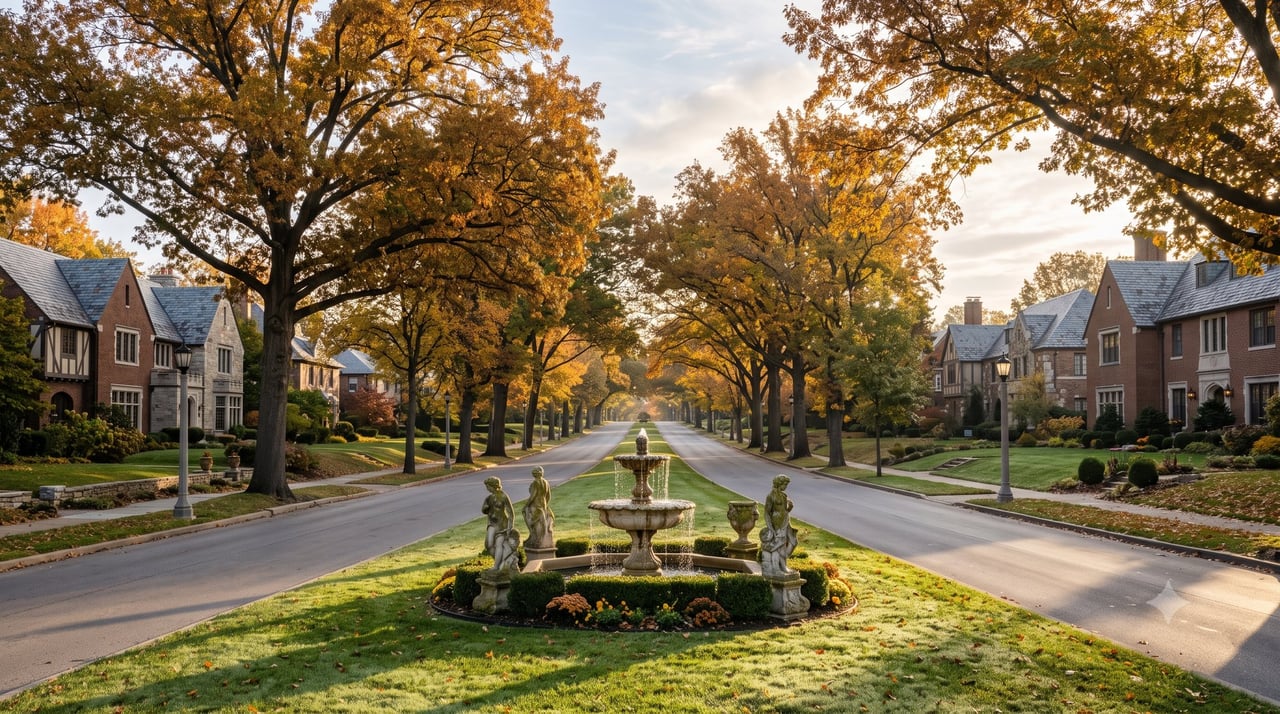
Some streets sell houses. Ward Parkway sells an idea of Kansas City. Ask nearly anyone in the metro to name the city's most beautiful drive and this boulevard, with its fountains, statuary, and canopy of mature trees, comes up first. Buyers searching for Ward Parkway Kansas City homes are usually drawn by that image: broad medians, deep setbacks, and estates that have anchored the city's south side for a century.
But the corridor is bigger than the boulevard itself. Just east, Armour Hills offers the same J.C. Nichols planning DNA in a friendlier package, with Tudors, bungalows, and Cape Cods on walkable blocks near Brookside and Waldo. Together they form one of the most livable stretches of historic Kansas City, with a price spectrum wide enough to include first-time character-home buyers and estate buyers alike.
Here is how the corridor works, from a team that sells and stages homes across it.
A Boulevard Built to Impress: The Nichols and Kessler Legacy
Ward Parkway was never an accident. Developer J.C. Nichols hired landscape architect George Kessler, who shaped much of Kansas City's boulevard system, to design the parkway as the centerpiece of his Country Club District. Nichols famously traveled to Italy and England collecting statues and monuments for the medians, which is why you pass pieces like the Meyer Circle Sea Horse Fountain, featuring a seventeenth-century Venetian sculpture, on an ordinary commute.
The boulevard runs nearly seven miles, tracing Brush Creek before turning south near the state line toward Wornall Road. It takes its name from Hugh Campbell Ward, a Kansas City attorney and Nichols business partner whose family land became part of the route; after his death in 1909, his wife Vassie James Ward carried the donation through.
The detail that matters for real estate: Nichols reserved the largest lots in the entire district for the houses facing the parkway. That single planning decision is why the boulevard remains Kansas City's signature estate address today.
What Ward Parkway Kansas City Homes Offer Today
Homes fronting the boulevard, and on the immediate side streets, are the corridor's showpieces. Expect 1920s and 1930s construction in brick, stone, and stucco: Colonial Revival, Tudor Revival, Mediterranean, and French-inspired designs, many with slate roofs, leaded glass, and formal gardens. Lots are deep, setbacks are generous, and the streetscape is protected by decades of consistent neighborhood stewardship, including an active Ward Parkway Homes Association.
The broader Ward Parkway neighborhood is more attainable than the boulevard's reputation suggests. According to Redfin, the median sale price in the Ward Parkway neighborhood was around $387,500 as of late 2025, up roughly 13 percent year over year, with homes typically going under contract in about 15 days. That median covers the neighborhood's full mix, from modest side-street homes to significant estates, and it confirms that well-presented homes here move quickly.
At the top of the market, boulevard-facing estates trade far above that median, and a meaningful share of them change hands quietly. Sellers of significant homes here often prefer discretion, which is where pre-market and off-market channels come into play.
Armour Hills: The Nichols Vision at Neighborhood Scale
Cross to the east side of the corridor and the scale changes, but the quality does not. J.C. Nichols purchased the Armour Hills land, named for the Chicago meatpacking family that owned it, in 1922, and built it out over the following decade as a moderately priced subdivision. The result is just over a thousand residential lots between Brookside Road, 65th Street, Oak Street, and Gregory Boulevard, filled with individually designed Tudors, bungalows, Cape Cods, and Dutch Colonials in brick, stone, and wood.
This is where the Nichols legacy feels most livable day to day. Arbor Villa Park sits at the heart of the neighborhood, the Armour Hills Homes Association remains active, and residents walk to four commercial districts: Brookside to the north, Waldo to the south, the Southtown corridor to the east, and Ward Parkway Center to the west. Few Kansas City neighborhoods put that much within a short stroll of a 1920s front porch.
For buyers priced out of Brookside proper, or wanting more character than a suburban starter home offers, Armour Hills is often the answer. These homes are smaller than the boulevard estates, but the craftsmanship, the tree cover, and the block-to-block consistency are cut from the same cloth.
One Corridor, Two Entry Points
Think of the corridor as a spectrum. Armour Hills is the entry point: charming, storybook homes that compete for attention with Brookside and Waldo listings and attract first-time buyers, young families, and downsizers who want walkability. The Ward Parkway neighborhood sits in the middle, blending approachable side-street homes with grander properties as you move toward the boulevard. The parkway frontage itself is the summit, where estate buyers shop alongside Mission Hills, Sunset Hill, and Hallbrook.
That range creates a useful dynamic. Owners often move within the corridor, starting in an Armour Hills Tudor and trading up toward the boulevard over time, which keeps demand steady at every rung. It also means pricing requires genuine local judgment. A comp pulled from three blocks away can sit in an entirely different market tier.
What Buyers Should Know Before Shopping Here
A few practical notes we share with every client considering this corridor:
These are century homes. Most of the housing stock dates to the 1920s and 1930s. That brings irreplaceable materials and detail, but inspections matter more than they do in newer suburbs. Pay attention to sewer lines, electrical updates, foundations, and how sensitively past renovations were done.
You are on the Missouri side. The corridor sits in Kansas City, Missouri, which means KCMO taxes and school options that many families here approach through a mix of public, charter, and the area's well-established private and parochial schools. Buyers comparing this area to Prairie Village or Leawood should weigh that difference early.
Competition is real for turnkey homes. Renovated character homes in Armour Hills and the Ward Parkway neighborhood draw multiple interested buyers because supply of well-updated 1920s housing is inherently limited. Nobody is building more of it. Having financing fully arranged and an agent who hears about homes before they hit the market is a genuine edge here.
Selling a Character Home Along the Corridor
Homes in this corridor reward presentation more than almost any other Kansas City market. A staged Tudor with its arched doorways, original hardwoods, and leaded glass highlighted properly photographs like something out of a design magazine. The same home cluttered or empty reads as small and dark, and buyers move on.
That is why our team stages every listing we take, at no charge to the seller, using our own furniture inventory and a staging team of four or more. An Armour Hills bungalow gets the same treatment as a boulevard estate, because both deserve to be seen at their best. And for owners of significant Ward Parkway homes who value privacy, our Compass affiliation gives us access to Compass Private Office, so a home can be exposed to serious buyers before, or instead of, a public launch.
Frequently Asked Questions
Is Ward Parkway a neighborhood or a street? Both. Ward Parkway is the nearly seven-mile boulevard, and it also lends its name to the surrounding residential neighborhood on the Missouri side of the state line. Listings described as "Ward Parkway" may sit directly on the boulevard or on nearby side streets, which are different price points.
How is Armour Hills different from Brookside? They are neighbors with the same walkable, 1920s character. Armour Hills is its own defined neighborhood south of 65th Street with its own homes association, and it often offers better value than the most sought-after Brookside blocks while sharing the same shops and restaurants.
Are homes along Ward Parkway protected by historic restrictions? There is no single blanket historic district, but active homes associations and deed restrictions dating to the Nichols era have preserved its character. Review a property's specific restrictions before planning exterior changes.
The Ward Parkway and Armour Hills corridor rewards buyers and sellers who work with someone who knows it street by street. If you are considering a move anywhere along it, contact Magnolia KC Group for a conversation about what your goals look like in this market.